

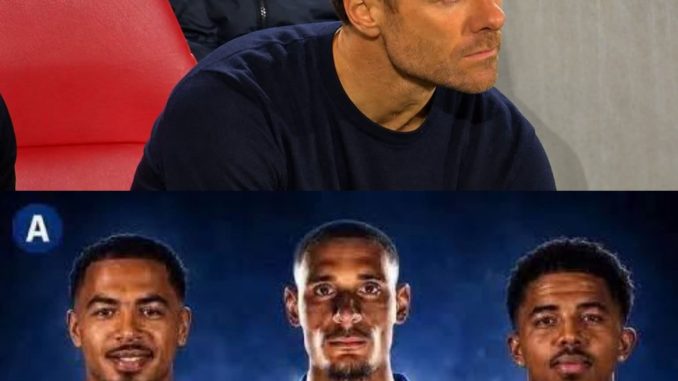

Does Xabi Alonso Need to End Chelsea’s Back Three Experiment?
Chelsea’s defensive problems are becoming harder to ignore, and Xabi Alonso now faces an important tactical question: should he continue with the back three, or is it time to try something different?
The Blues have shown flashes of attacking quality under Alonso, but defensive consistency remains a major concern. After five Premier League matches, Chelsea have already conceded 12 goals, with the latest setback coming in a disappointing 3-0 defeat away to Brentford.
Against Brentford, Alonso returned to a three-man defence consisting of Wesley Fofana, Maxence Lacroix and Levi Colwill, with Pedro Neto and Pep Chavarría operating as wing-backs.
On paper, that defensive unit has plenty of quality.
But the bigger question is whether the system is giving Chelsea the defensive stability Alonso needs.
Chelsea’s Back Three Is Under Pressure
The idea behind a back three is understandable.
It can give Chelsea an extra central defender, allow the wing-backs to push higher and provide more options during build-up. Alonso has already shown that he is willing to change formations depending on the opposition and the players available to him.
However, having three centre-backs does not automatically mean a team will defend better.
Chelsea have continued to concede goals despite using different defensive structures. The team used a back four against Hull City, with Wesley Fofana and Levi Colwill in central defence, but Alonso returned to a 3-4-2-1 against Brentford.
That flexibility can be useful, but Chelsea need more than tactical variety.
They need defensive stability.
Fofana, Lacroix and Colwill — Is the Partnership Working?
The combination of Fofana, Lacroix and Colwill looks strong when viewed individually.
Fofana brings pace and recovery ability. Lacroix offers physical presence and experience in a central role, while Colwill provides composure and quality on the ball.
Alonso has previously spoken about the complementary qualities of Colwill and Lacroix, particularly highlighting Colwill’s ability to contribute during build-up play.
The problem is that individual quality does not always translate into collective defensive security.
A back three depends heavily on communication, positioning and the protection provided by the midfield and wing-backs.
When those areas become disconnected, the centre-backs can suddenly find themselves defending large spaces.
That appeared to be one of Chelsea’s problems against Brentford.
Chelsea Conceded Three More Against Brentford
Chelsea went into the Brentford match looking to recover from the 2-2 draw against Hull City.
Instead, the Blues suffered another setback.
The match was goalless at half-time, but Brentford eventually broke through in the second half. Jaidon Anthony opened the scoring before Igor Thiago added a second, with Fábio Carvalho completing the 3-0 victory in stoppage time.
The scoreline once again highlighted Chelsea’s difficulty in maintaining defensive concentration throughout an entire match.
Alonso himself has spoken about Chelsea’s need for greater consistency and the importance of maintaining their level across 90 minutes.
And that could be one of the biggest challenges facing the Spanish coach during the early stages of his Chelsea project.
The Problem May Be Bigger Than the Formation
It would be easy to blame the back three after another heavy defeat.
But Chelsea’s defensive problems may not simply be caused by playing three centre-backs.
The midfield structure, wing-back positioning, pressing intensity and transition defence all have an influence.
When Chelsea lose possession high up the pitch, the team needs to react quickly.
If the wing-backs are too high, the midfield does not recover quickly enough and the opposition finds space, the three centre-backs can be exposed despite having an extra defender.
That means Alonso may not necessarily need to completely abandon the back three.
Instead, he may need to find a more reliable balance within it.
Alonso Has Already Shown He Is Willing to Change
One positive for Chelsea is that Alonso has not been completely stubborn with his tactics.
The manager has already experimented with different formations during the opening weeks of the season.
Chelsea used a back four against Hull City after defensive concerns had emerged earlier in the campaign, before returning to a back-three system against Brentford.
That tactical flexibility could become important as the season progresses.
The question is no longer whether Alonso can change the system.
The question is which system gives Chelsea the best defensive balance with the players available.
Should Chelsea Try a Back Four Again?
A back four could give Chelsea a different defensive structure.
Instead of relying on two wing-backs to provide width while also recovering defensively, traditional full-backs could potentially offer more natural defensive positioning.
It could also allow Alonso to use two central defenders and an additional midfielder or attacker, depending on the opponent.
But there are risks.
Chelsea’s squad has been built to offer tactical flexibility, and Alonso has shown a preference for formations that allow his wing-backs to push forward.
Abandoning the back three completely could therefore create different problems.
The answer may not be as simple as saying “back three bad, back four good.”
Chelsea Need More Defensive Consistency
Whatever formation Alonso chooses, one thing is becoming clear: Chelsea cannot continue conceding at this rate if they want to compete consistently at the top end of the Premier League.
Twelve goals conceded in five league matches is a significant defensive concern.
Chelsea have enough attacking quality to create problems for opponents, but defensive mistakes can quickly undo good attacking work.
That was evident in the early-season results.
The Blues started the Premier League campaign with wins over Fulham and Brighton, but then suffered a defeat against Arsenal, drew with Hull City and lost heavily to Brentford.
The inconsistency means Alonso now has an important period ahead of him to work on Chelsea’s defensive organisation.
Is the Back Three the Real Problem?
This is where the debate becomes interesting.
Should Chelsea fans blame the formation?
Or should the focus be on how the players are executing it?
A back three can work extremely well when the midfield protects the defence, the wing-backs recover quickly and the centre-backs maintain their positions.
But when those pieces fail to work together, the formation can look extremely vulnerable.
Fofana, Lacroix and Colwill are not suddenly bad defenders because Chelsea conceded three goals against Brentford.
However, Alonso will need to decide whether this particular combination and structure is producing the defensive security he wants.
Alonso Has a Big Defensive Decision to Make
The international break gives Alonso an opportunity to analyse what has gone wrong.
Chelsea’s next Premier League match is against Bournemouth on October 10, giving the manager time to work on defensive organisation and potentially reassess his tactical approach.
The solution could be a different formation.
It could be a different defensive partnership.
It could be changes in midfield.
Or it could simply be better concentration and organisation from the players already in the team.
But something has to improve.
Chelsea cannot afford to keep giving opponents opportunities and expecting their attacking players to rescue every match.
Leave a Reply